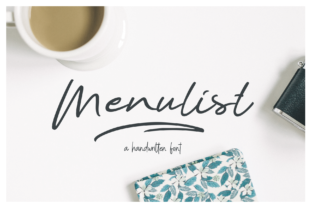
Menulist Font Review: A Signature Script for Modern Brands
I was staring at a blank brand board for a new artisanal café. The initial sketches felt stiff, leaning too far into the stark minimalism of a sans serif. I needed something that whispered “handcrafted” without shouting “rustic.” So, I dragged Menulist onto the workspace. Menulist Script is a signature-style handwritten font, and from the first glance, its minimalist style did exactly what I needed: it added personality without clutter.
I typed the café’s name. Immediately, it felt less like a font and more like a confident, natural signature. There was no excessive flourish, no overly dramatic swash. The characters flowed together with a clean, connected grace. This wasn’t a rough, casual scribble; it was deliberate and polished, yet unmistakably human. That’s the core appeal of Menulist—it occupies that sweet spot between professional polish and authentic touch.
Using Menulist for Logo Design and Signature Branding
Menulist proved itself instantly as a logo font. In my test, I applied it to a simple, single-line logo concept. The connected script style created a cohesive, memorable wordmark that felt both unique and approachable. Because of its minimalist nature, it didn’t compete with other logo elements; it anchored them. I compared it to other, more ornate script fonts, and Menulist stood out by being more versatile. Its clarity meant it would scale well—from a tiny favicon to a large storefront sign—without losing its essential character.
This signature-style handwritten font excels in creating what I call “signature branding.” Think of a personal brand for a creative studio, a boutique winery’s label, or a skincare line emphasizing purity. Menulist delivers that authored, curated feel. It’s a premium font that suggests care and attention, making it ideal for businesses built on a story or a personal touch.
Menulist in Packaging Design and Product Labels
Moving from the logo to a packaging mockup was the real test. I placed the font on a minimalist coffee bag label. The script worked beautifully for the product name headline, instantly elevating the perceived value. Its handwritten quality conveyed “small batch” and “artisan,” while its clean lines maintained a modern, sophisticated look that appeals to contemporary shoppers. For secondary information like “Net Weight” or ingredients, I paired Menulist with a simple, neutral sans serif. This combination is key: let Menulist shine as the hero display font for the brand name or key product line, and use a supporting typeface for mandatory text.
This principle applies broadly. Menulist is fantastic for product labels, limited-edition branding, and any packaging where you want the name to feel special and signed. It’s less suitable for the dense body text of usage instructions or legal disclaimers—readability at small sizes for long passages can be a challenge, as with most connected scripts.
Menulist for Website Headers and Social Media Graphics
Digital applications are where a font’s versatility truly gets tested. I used Menulist in a website header mockup. As a hero headline, it created immediate warmth and connection, breaking the coldness of a purely geometric layout. The font’s organic flow guided the eye pleasantly across the page. For social media layouts, especially Instagram graphics or Pinterest pins for a handmade shop, Menulist added that crucial human element. A quote overlay or a promotional banner felt less like generic marketing and more like a personal note from the maker.
When considering Menulist for web design, think display. It’s perfect for key headlines, callout phrases, or navigational accents. For body text, you’ll always want a more readable serif or sans serif. If you’re offering the font as a webfont for client projects, its minimalist style ensures it loads and renders cleanly without complex details that can cause rendering issues on some browsers.
Pairing Menulist with Other Fonts in a Brand System
A successful brand identity relies on a harmonious typography system. Menulist’s strength is its simplicity, which makes pairing straightforward. It works exceptionally well with clean, modern sans serifs like geometric options. The contrast between the human script and the structured sans creates a balanced, contemporary brand board. For more traditional or editorial feels, try pairing it with a classic serif font. The combination can lend authority and elegance to the personal touch of the script.
Avoid pairing it with other overly decorative script fonts or handwritten fonts; that usually leads to visual competition and clutter. Let Menulist be the sole script voice in your system. Its role is to provide the signature accent, not to fill every typographic need.
Testing Menulist Before Final Client Approval
Before committing any font to a final client project, I always run practical tests. With Menulist, I printed it on a business card mockup. The script remained crisp and legible at that small scale for the business name, reaffirming its logo suitability. I also tested it in a dense editorial-style layout (like a menu or brochure) to confirm its limitations: it’s not for body text. This is a critical step. Always test your fonts in the actual contexts you’ll use them—on your packaging template, in your website header builder, on your social media image dimensions.
Also, verify the commercial font licensing. Most fonts like Menulist are sold with a commercial license, but always confirm it covers your intended use—client brand identity, product packaging, merchandise, or digital templates. This protects you and your client for future scaling.
Ultimately, Menulist is a remarkably useful tool in the designer’s kit. It’s a script handwritten font that avoids the extremes of being too casual or too formal. Its minimalist style helps your projects stand out by adding a confident, personal signature without overpowering the design. For brand designers, entrepreneurs, and creators looking to infuse authenticity into a modern visual identity, Menulist offers a reliable, elegant, and versatile solution.